A Lab for Human Flourishing
Edition001
Introducing JPL Industrial Arts
Opening
Nothing in the first 25 years of my life could have prepared me for the endurance challenge of living through the 21st century.
I spent most of my adolescent and early adult years, roughly 1989–2000, dreaming of the future. My waking hours were enmeshed in some combination of art, design, reading, and making. I learned to code using HyperCard, made flyers for my friends’ bands in Photoshop 1.0, and obsessed over every William Gibson and Bruce Sterling book I could find. I read about emergent technologies in the pages of Wired and Mondo 2000, giddy with the possibilities of a new digital age.
Not long after the World Wide Web was born, I wrote my first HTML on a website hosted on a university server. To get that space, you had to walk up to a physical desk and fill out a sheet of paper. About a week later, I received an email with my website address and FTP instructions. I spent hours each day in my art department’s Digital Art Lab, working on hulking Macintosh computers with enormous CRT monitors, storing files on Zip drives, and dreaming about what we would be able to make in just a few years.
The web evolved, and I found my first jobs, first in technology and then in marketing. The dot-com bubble burst. The towers fell. Hurricane Katrina hit. Before long, I was running an agency I’d built, making websites for businesses in post-Katrina New Orleans.
Around the same time, Web 2.0 arrived, and the social media age began. Then came the 2008 financial crash. I spent the next decade helping build and market one of America’s great museums. Trump became president. COVID came. I decided to strike out on my own again, building marketing systems and managing media for small businesses.
Now large language models are gobbling up the knowledge and expertise I’ve spent a lifetime accumulating, packaging it into machine workflows.
Some of what these tools make possible is extraordinary. I’m still excited about making things with them. But somewhere along the way, my excitement about the future became tangled up with the exhaustion of trying to survive it. Every new possibility seems to arrive with another upheaval in the conditions of work, culture, and everyday life.
It often feels like a never-ending tsunami of shit. We’re caught in the turbulent slipstream of a fragmented society, watching our culture, economy, and political structures strain under one crisis after another.
How is this the future we ended up with? How the hell did we get here? And can we still make something better?
This experimental publication attempts to answer those questions. I want to examine the past, present, and possible futures of our world by looking closely at moments when new possibilities for human life emerged: what made them possible, what sustained them, and what eventually captured or diminished them.
Three questions will guide the investigation:
- What kinds of systems, environments, institutions, and tools have helped people flourish at particular moments in the modern and postmodern eras?
- What survived those moments—in buildings, objects, institutions, ideas, and everyday practices—and what was lost?
- What forces diminished those possibilities, and what might we learn about sustaining them?
By flourishing, I mean having the security, time, and freedom to develop our abilities, care for one another, make meaningful things, and participate in shaping the world around us. There should be room in that definition for curiosity, pleasure, and beauty, too.
By investigating these questions, I hope to better understand our past, get a firmer grip on our present, and begin to imagine better futures. That last part feels especially difficult. When so much of our attention is consumed by responding to the immediate demands of life, imagining something beyond them can seem almost indulgent.
I want to make some room for it anyway.
Patterns
My starting proposition is that flourishing depends on the relationships between things: the arrangements of space, technology, work, governance, culture, and communication that shape everyday life.
Looking back, even that university art lab was an arrangement worth examining. There were tools I could use, a place to work, an institution providing access, and time to get lost in an idea. The possibilities I felt in front of those computers depended on conditions that extended well beyond the machines themselves.
I want to pay closer attention to those conditions.
Christopher Alexander offers one starting point. In The Timeless Way of Building and the collaborative A Pattern Language, he developed an approach to understanding and making environments through recurring patterns. These patterns connect problems encountered in everyday life with spatial arrangements that might help resolve them, working across scales from a room to a neighborhood or town. His work also places the people who inhabit those environments at the center of making them.
For this project, I want to carry that attention to relationships into other areas of life. A workshop depends on tools, but also on access, shared knowledge, and time. A public gathering place depends on its physical form, but also on whether people feel welcome, whether they can reach it, and whether they can afford to remain. A useful institution needs people capable of maintaining it and a purpose they can continue to believe in.
The SBB railway clock and Vignelli’s calendar provide two small starting points. I’m drawn to the clarity of their forms and the attention they give to an ordinary human need: orienting ourselves in time. The clock belongs to the shared world of railway stations and schedules. The calendar brings the passage of days into view.
To me, these objects suggest a kind of care worth investigating. They make something we encounter every day easier to understand. Following the clock leads toward questions about public infrastructure and coordination. Following the calendar leads toward work, attention, and the organization of a day.
This is the scale of attention I want to practice: beginning with something concrete, then tracing the relationships that give it meaning and make it useful.
Learning From Earlier Futures
Those relationships have histories.
The first investigations will move through Vienna around 1900 and the later experiment of Red Vienna; Weimar and Frankfurt; postwar Britain; Olivetti and its wider ambitions; and the school at Ulm. I want to understand these moments through the connections between their cultural experiments and their attempts to reorganize everyday life.
In Red Vienna, municipal housing formed part of a broader program of social, health, and educational reform. At Olivetti’s Ivrea, the industrial project encompassed factories, housing, and buildings for social services. These are useful places to begin asking how design participated in a larger conception of what life could become.
Each case raises questions that extend beyond its most familiar buildings, objects, or personalities. How were its ambitions financed and organized? What did they mean for the people who lived and worked within them? Who participated in defining a better life, and who was left out of that definition?
I want to look closely enough to understand the achievements alongside their contradictions. That means examining the institutions, working relationships, political commitments, and material resources that supported an experiment, as well as the pressures that weakened it.
It also means asking more carefully what we mean when we say something survived.
A building can remain standing while the social program that gave it purpose disappears. A visual language can remain influential after its political ambitions have been forgotten. An idea can travel with people forced into exile and find a new application somewhere its authors never expected.
What, exactly, endured? What changed in the process? What remains useful?
Approaching these histories as earlier futures gives them a particular relevance. Their participants were working with incomplete knowledge, practical constraints, and competing ideas about what should come next. I want to understand how they made possibilities tangible—and what happened once those possibilities encountered the world.
Understanding the World We Inhabit Now
Eventually, those histories bring us back to the present.
The question becomes how systems that promise greater freedom, connection, and capability can come to consume so much of our time and limit our ability to act.
Digital platforms offer one place to investigate this. Cory Doctorow’s account of enshittification describes how platforms can redirect value away from the users and businesses that depend on them toward their owners, particularly when those users have difficulty leaving and the owners face few effective constraints.
That gives me a way to reconsider the distance between the web I first encountered and the systems I work within today. What happens when a place for making and sharing becomes an environment organized around holding attention? How does the relationship change when participation depends on rules, rankings, and access controlled by someone else?
These questions run directly through my working life. I’ve spent decades helping organizations communicate, find audiences, and build their presence within these systems. The systems I want to examine are also the ones I use to earn a living.
The inquiry extends into the physical world as well. When housing is evaluated primarily as an investment, what happens to its purpose as a place to live? When an institution is judged primarily by what it can cut, what happens to its capacity to serve? What kinds of work become invisible when maintenance and care receive less attention than expansion and novelty?
Financialization, surveillance, consolidation, and institutional decay need to be understood through their consequences for ordinary life. Who controls the things people depend on? What do those systems reward? Who has the power to change them?
There are material consequences to examine, too: the energy, land, labor, and resources required to sustain a particular way of life, and the people and environments that bear its costs.
I want to understand how these pressures interact, how they become embedded in everyday arrangements, and where those arrangements can still be changed. The question of human flourishing has to include both our ability to shape our lives and the conditions that allow those lives to continue.
Imagining a Better Future
JPL is a place to work on these questions through reading, writing, observation, and making.
The publication will move between historical investigations, notes, collected references, and experiments. Some questions may be best approached through an essay. Others may become clearer through reconstructing an object, making a small tool, documenting a place, or trying a different way of organizing work.
The making matters to me. Working through a design can reveal decisions that remain hidden when I only look at the finished object. Trying to use a historical idea under present conditions can expose both its possibilities and its limits. An experiment can give an otherwise abstract question something concrete to push against.
I want to recover useful patterns and see what they might become now. That requires understanding the circumstances that made them work, then considering what would have to change for them to serve people living under different conditions.
A shared workshop, a public institution, a piece of software, or a way of organizing a working day might each offer something to investigate. The questions remain practical: Who can use it? What does it make possible? What does it demand in return? Who maintains it, and who gets to decide how it changes?
The scale will vary, but I want to keep returning to the texture of ordinary life. Does an arrangement give people more time and agency? Does it help them learn, make, care, or participate? Can it remain useful as circumstances change? Can the people who depend on it have a meaningful say in its future?
I expect some of these investigations to complicate the ideas that drew me to them. I want the publication to leave room for that—for uncertainty, revision, and the occasional experiment that leads somewhere I hadn’t intended.
Part of what I’m trying to recover is the feeling I had in that university art lab: that there was a world opening up, and I might have a hand in making it.
This time, I want to understand what would allow more people to share in that possibility, and what it would take to sustain it.
In this Edition
11 entries · Artifacts, Library, Ephemera
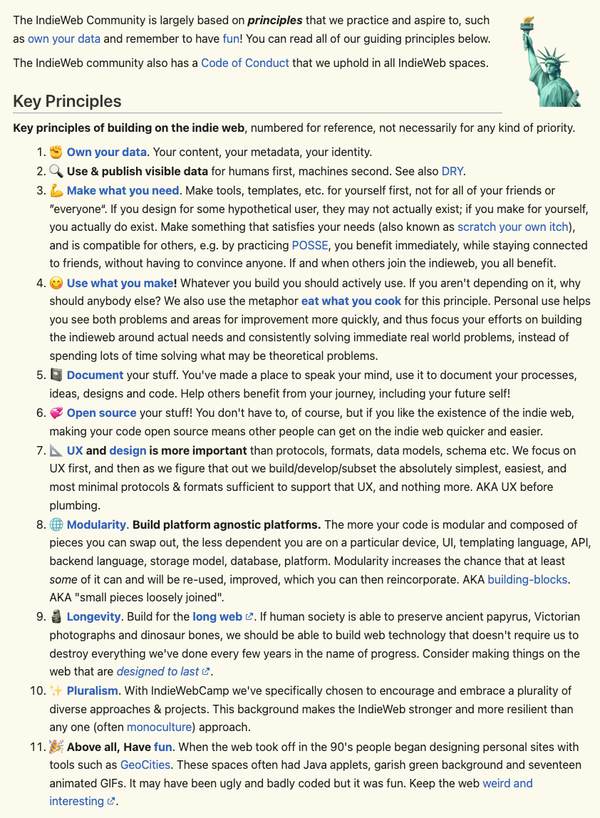
- Library · IndieWebCamp, 2011IndieWeb Principles
- Library · Maggie Appleton, 2020A Brief History & Ethos of the Digital Garden
- Library · Yancey Strickler, 2019The Dark Forest Theory of the Internet

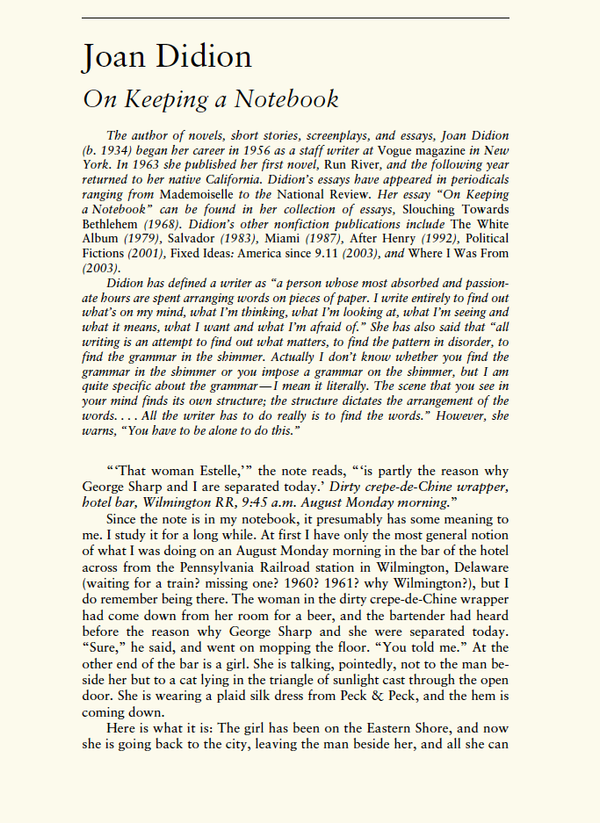
- Library · Joan Didion, 1966On Keeping A Notebook
- Library · Walter Benjamin, 1931Unpacking My Library
- Library · Gilles Deleuze & Félix Guattari, 1980A Thousand Plateaus
- Library · Christopher Alexander, 1977A Pattern Language
- Ephemera · 15 March 2026Eventually Everything Connects